Bert
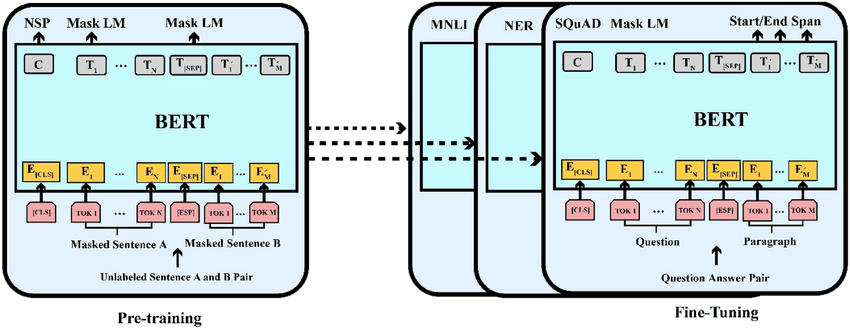
BERT (Bidirectional Encoder Representations from Transformers) is a pre-trained language model introduced by Google's research team. It has significantly advanced the state-of-the-art in various NLP tasks. Unlike traditional language models, BERT is bidirectional, meaning it considers both left and right contexts of words. The core architecture of BERT is based on the Transformer model, using self-attention mechanisms to capture long-range dependencies.
BERT is pre-trained on two tasks: masked language modeling (MLM) and next sentence prediction (NSP). This approach allows BERT to excel in tasks like text classification, named entity recognition, question answering, and sentiment analysis.
Data
The following table summarizes the data used to train BERT:
| Type | Count |
|---|---|
| Total words | 2.2 billion |
| Unique words | 22.94 million |
| Total sentences | 181.45 million |
| Total documents | 17.52 million |
Training
BERT was trained using the following hyperparameters:
| Hyper-parameter | Value |
|---|---|
| vocab_size | 50,000 |
| hidden_size | 768 |
| num_hidden_layers | 12 |
| num_attention_heads | 12 |
| learning_rate | 0.00005 |
| batch_size | 110 |
Results
After training, BERT achieved the following results:
| Metric | Value |
|---|---|
| Training loss | 1.8633 |
| Evaluation loss | 1.4681 |
| Perplexity | 4.3826 |
| NER Precision | 0.8475 |
| NER Recall | 0.7390 |
| NER Macro F1 | 0.7786 |
| POS Precision | 0.8838 |
| POS Recall | 0.8543 |
| POS Macro F1 | 0.8611 |
Deliverable Files
The deliverables for BERT include the following files:
config.json- JSON file with model configurationspytorch_model.bin- Model weights in PyTorch formatspecial_tokens_map.json- Token information for the tokenizertokenizer_config.json- Tokenizer configurationsvocab.txt- Vocabulary file